Scaling Knowledge Graphs for Enterprise Teams in 2026
Scaling knowledge graphs for enterprise teams: governance, team structure, knowledge graph RAG and implementation best practices. Explore the 2026.
Table of Contents
- Why Scaling Knowledge Graphs for Enterprise Teams Breaks After the Pilot
- What Actually Changes Between 10,000 and 10 Million Triples
- The Five Dimensions of Scale: Entities, Relations, Sources, Users, Queries
- Architecture Choices That Decide Whether You Can Scale at All
- Knowledge Graph RAG: Grounding Retrieval in a Graph Instead of a Vector Index
- Knowledge Graph Implementation Best Practices for Growing Teams
- Data Quality at Scale: Entity Resolution, Provenance, and Drift
- Team Structure: Who Owns an Enterprise Knowledge Graph
- Governance, Audit Trails, and the Regulatory Reality
- Performance, Cost, and Query Latency as the Graph Grows
- Build Versus Buy: Where Enterprise Teams Get Stuck
- Pitfalls That Stall Knowledge Graph Programmes
- Conclusion: What to Fix First
- Frequently Asked Questions
Last Updated: 14 September 2026
Why Scaling Knowledge Graphs for Enterprise Teams Breaks After the Pilot
Most enterprise knowledge graph programmes do not fail at the proof of concept. They fail at month nine, when the graph that impressed everyone in the demo starts returning stale answers and the team that built it has moved on to other work. Scaling knowledge graphs for enterprise teams is a different discipline from building one, and the gap between the two catches almost everyone.
This guide from Certant is for the teams living through that gap: knowledge managers unifying internal data, compliance officers who need every answer traceable to a source paragraph, and IT directors running sovereign or air-gapped deployments. Below, we break down what actually changes as a graph grows, which architecture decisions lock you in early, and what to fix first when a programme stalls.
A knowledge graph is a structured representation of entities, their relationships, and the sources that support those relationships, stored so that queries can traverse the connections rather than search flat text. That definition matters because every scaling problem you will hit traces back to one of those three parts growing at a different rate.
What Actually Changes Between 10,000 and 10 Million Triples
The mechanics change, not just the volume. At 10,000 triples, a graph fits comfortably in memory and every query feels instant (Storage and Query of Drug Knowledge Graphs Using Distributed Graph Databases: A Case Study). At 10 million, the same query patterns start competing for resources, and the bottlenecks appear in different places than you would expect.
Three things shift at roughly the same time:
- Traversal depth becomes expensive. A two-hop query that ran in milliseconds now touches thousands of intermediate nodes (Parametric Traversal for Multi-Dimensional Cost-Aware Graph Reasoning).
- Entity resolution stops being a clean-up task. Duplicates you could fix by hand at small scale become a continuous process.
- Provenance storage outgrows the graph itself. Every triple needs a source pointer, and those pointers accumulate faster than the assertions do (Name That Graph).
Teams that plan for volume alone usually miss the third point. The graph is not the biggest asset you are maintaining. The audit trail behind it is.
The Five Dimensions of Scale: Entities, Relations, Sources, Users, Queries
Scale is not one number. It is five, and they grow independently. A graph can hold millions of entities and still fall over because query concurrency doubled, or because a new document source introduced a second naming convention for the same customer.
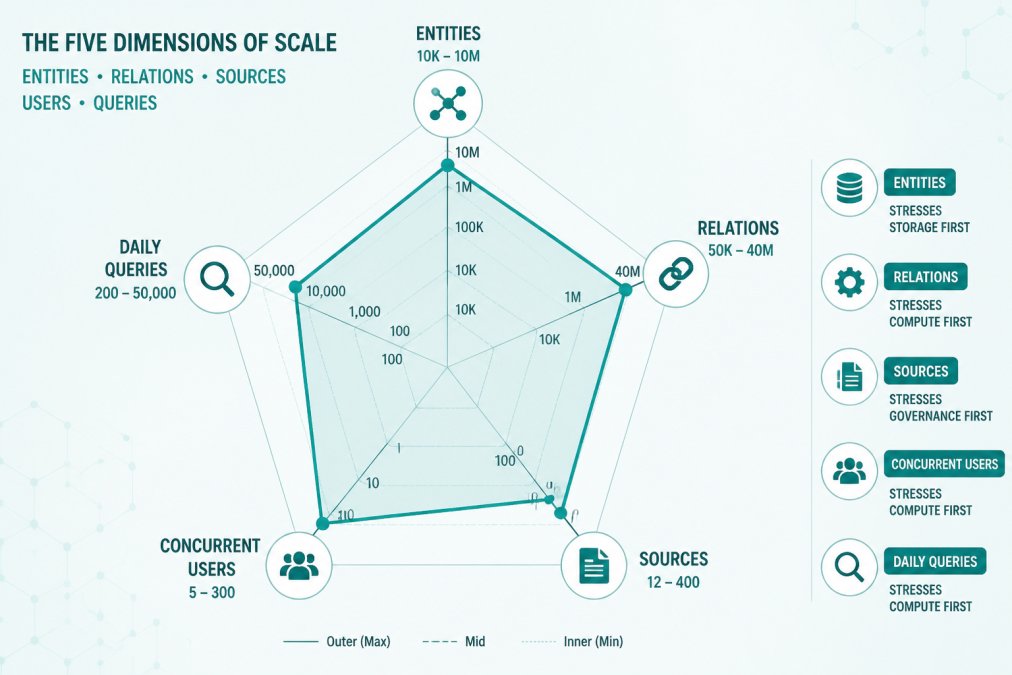
Each dimension stresses a different part of the system:
| Dimension | What it stresses | First symptom of strain |
|---|---|---|
| Entities | Storage and indexing | Slow entity lookups |
| Relations | Traversal compute | Query timeouts on deep paths |
| Sources | Ingestion pipeline | Stale answers from unprocessed documents |
| Users | Access control | Permission leaks across teams |
| Queries | Concurrency and caching | Latency spikes at peak hours |
The practical consequence: you cannot size infrastructure from a single growth estimate. Track all five, and watch which one moves first.
Architecture Choices That Decide Whether You Can Scale at All
Storage and ontology decisions made in week two determine what is possible in year two. Neither is easy to reverse once downstream applications depend on the graph, so it is worth slowing down at exactly the point where teams usually rush.
Graph store, triple store, or property graph: what each buys you
The three main options trade flexibility against query power in different ways.
A triple store holds subject-predicate-object statements and is the natural fit when standards compliance and interchange matter more than query convenience. A property graph attaches key-value properties to nodes and edges, which makes application development faster but ties you more tightly to a specific vendor's query language. A general graph database sits between the two, offering traversal performance without forcing a strict schema.
Choose based on what your team will actually query. If auditors need to trace an answer back through a chain of assertions, a triple store's explicit statement model makes that easier to demonstrate. If your engineers are building interactive tools on top, a property graph will get them there sooner.
Where the ontology lives, and why it matters later
The ontology is the schema of meaning: which entity types exist, which relationships are permitted, and what the constraints are. Where you store it changes how painful migration becomes.
Keeping the ontology inside the graph store is convenient early and awkward later, because schema changes and data changes get tangled together. Keeping it in version control as a separate artefact adds a step to every deployment, but it means you can diff, review, and roll back the model independently of the data. For regulated environments, that separation is usually worth the friction.
Knowledge Graph RAG: Grounding Retrieval in a Graph Instead of a Vector Index
Knowledge graph RAG is a retrieval approach that uses graph structure and relationships to select context for a language model, rather than relying on vector similarity alone. The graph supplies the connections; the model supplies the language.
Pure vector search retrieves passages that look similar to the question. That works well until the question depends on relationships the embedding never captured. Ask which contracts a specific clause applies to, and similarity search returns passages containing similar words, not the contracts actually bound by that clause.
When hybrid retrieval beats pure vector search
Hybrid retrieval combines graph traversal with vector search, and it earns its complexity in specific situations:
Build a brain for your company →
- The answer depends on relationships between entities, not just topical similarity
- Questions span multiple documents that share an entity but little vocabulary
- Traceability is required, so every retrieved passage must link to a source node
- The corpus contains near-duplicate language where similarity alone cannot discriminate
For straightforward question answering over a single well-written document set, vector search is simpler and often sufficient. The moment your users start asking relational questions, the graph stops being optional.
Knowledge Graph Implementation Best Practices for Growing Teams
The practices that matter most are the ones that cost little now and a great deal later. Knowledge graph implementation best practices for growing teams cluster around two areas: modelling discipline and change management.
Modelling decisions that are cheap now and expensive later
Reifying a relationship, meaning turning it into its own node so you can attach metadata, feels like overkill when you have 200 edges. At 200,000 edges, with three different teams wanting to record who asserted what and when, it is the difference between a clean model and a migration project.
The same applies to naming. Pick one convention for entity identifiers and enforce it at ingestion. Mixed conventions are tolerable at small scale because humans can spot the duplicates. At scale, they become an entity resolution problem you created for yourself.
Change management: versioning, deprecation, and migration
Graphs change while applications depend on them. Treat schema changes the way you treat API changes:
- Version the ontology and publish a changelog
- Deprecate entity types and predicates before removing them
- Run migrations against a copy, then validate before promoting
- Keep a rollback path for every structural change
Data Quality at Scale: Entity Resolution, Provenance, and Drift
Data quality stops being a clean-up exercise and becomes a permanent operational function. Three problems dominate, and all three get worse with volume rather than better.
Entity resolution is the process of determining when two records refer to the same real-world entity. At small scale, a human reviews the matches. At scale, you need scoring thresholds, blocking strategies to avoid comparing every pair, and a review queue for borderline cases. Set the threshold too loose and you merge distinct entities; too tight and you fragment one entity across several nodes.
Provenance is the record of which source supports each assertion. Every triple should point back to a specific document, version, and location. Without that, you cannot answer the auditor's question, and you cannot tell which assertions to invalidate when a source is superseded.
Drift covers both the slow divergence of the graph from its sources and the gradual change in how users phrase their questions. Schedule reconciliation against source systems, and review failed queries periodically. The questions your users ask in year two are rarely the ones you designed for.
Team Structure: Who Owns an Enterprise Knowledge Graph
Ownership is the decision most organisations defer, and it is the one that determines whether the graph survives its first reorganisation. A graph with no named owner becomes nobody's problem at exactly the moment it needs attention.
A workable structure separates three responsibilities. An ontology owner decides what the model means and approves structural changes. Data stewards, usually sitting close to the source systems, own the quality of what enters the graph from their domain. A platform team runs the infrastructure, ingestion pipelines, and access control.
The common mistake is assigning all three to one person during the pilot and never revisiting it. That works for six months. After that, the ontology owner is too busy with ingestion failures to review model changes, and the model drifts.
Governance, Audit Trails, and the Regulatory Reality
Regulated industries do not get to treat traceability as a nice-to-have. When an answer influences a compliance decision, someone will eventually ask how the system arrived at it, and "the model said so" is not an answer.
Effective governance for a knowledge graph rests on a few concrete capabilities:
- Every assertion links to a source document, version, and location
- Every query result can be reproduced from a recorded graph state
- Access control applies at the entity and relationship level, not just the application level
- Retention and deletion policies cover graph nodes as well as source documents
Certant is designed around this requirement, with verifiable answers that cite the source paragraph rather than presenting an unsupported conclusion. For teams in financial services and healthcare, that citation trail is what makes the difference between a tool that can be deployed and one that cannot.
Performance, Cost, and Query Latency as the Graph Grows
Latency degrades in predictable ways, and the fixes are cheaper when you apply them before users notice. Most performance problems in growing graphs come from a small number of query patterns rather than from overall volume.
The usual culprits:
- Unbounded traversals that follow relationships without a depth limit
- Missing indexes on the properties used most often in filters
- Repeated subgraph computation that could be materialised once and cached
- Hot entities that appear in a disproportionate share of queries
Cost follows a similar pattern. Storage grows linearly with triples, but compute grows with traversal depth and concurrency, which are harder to forecast. Track query cost per user journey rather than per query, and you will see which features are actually expensive to serve.
Build a brain for your company →
Build Versus Buy: Where Enterprise Teams Get Stuck
The build-versus-buy question usually stalls because teams compare the wrong things. They compare licence costs against engineering salary, and miss the ongoing operational burden that determines the real total.
Building in-house gives you complete control over the model and the deployment. It also means you own entity resolution, provenance storage, access control, and every future migration. That is a reasonable trade for organisations with a genuine platform team and a graph that is central to their product.
Buying shifts that operational load to a vendor, at the cost of some flexibility in how the graph is structured. For teams whose core business is not graph infrastructure, this is usually the faster path to something that survives contact with production.
Certant sits in the second category, with a platform that builds a live knowledge graph from internal documents and data, supports sovereign, air-gap-capable, and on-premises deployments, and runs on AWS Bedrock, Azure AI, GCP Vertex, or local GPUs. There is no-install, low-risk implementation process, so a team can start with a single document set and expand from there. Pricing is available on the Certant pricing page, and there is a free plan for teams that want to test the approach before committing.
Pitfalls That Stall Knowledge Graph Programmes
Programmes rarely fail from a single technical fault. They stall from a handful of recurring patterns, and most are organisational rather than architectural.
- No named owner after the pilot. The graph degrades quietly while everyone assumes someone else is maintaining it.
- Ontology treated as configuration. Changes ship without review, and downstream tools break without warning.
- Entity resolution deferred. Duplicates accumulate until fixing them is a project rather than a task.
- Provenance bolted on later. Retrofitting source links across millions of assertions is far harder than capturing them at ingestion.
- Success measured by graph size. Triple count grows while answer quality stays flat or falls.
The last one is the most damaging, because it makes a failing programme look healthy on the dashboard.
Conclusion: What to Fix First
The hardest part of scaling knowledge graphs for enterprise teams is not the technology. It is deciding what to fix first when everything looks urgent and the pilot's momentum has run out.
Start with ownership and provenance. Name who owns the ontology, and make sure every assertion links back to its source. Those two decisions make everything else tractable: you can measure quality, you can answer auditor questions, and you can change the model without losing the thread.
Certant builds the knowledge graph from your existing documents and data, returns verifiable answers with citations to source paragraphs, and supports sovereign and air-gapped deployments for regulated environments. Get started with Certant and turn a stalled pilot into a graph your team can actually maintain.
Frequently Asked Questions
What are the primary challenges when scaling knowledge graphs?
The same four keep surfacing: entity resolution across sources that disagree, ontology drift as teams add their own vocabulary, query latency as the graph grows past a few million triples, and governance that auditors will actually accept. Each is manageable in isolation. The difficulty is that fixing one often worsens another, so scaling knowledge graphs is really a sequencing problem rather than a technology problem.
How do you maintain data quality in a large-scale knowledge graph?
Treat quality as a pipeline, not a clean-up project. Score every ingested source for freshness and completeness, run entity resolution with a confidence threshold you can tune, and attach provenance to every triple so a bad claim can be traced back to the document that produced it. A weekly drift report on duplicate entities and orphaned nodes catches most decay before users notice.
What team structure is required to manage an enterprise knowledge graph?
Three roles cover most enterprise deployments: an ontology owner who decides what the graph means, data engineers who run ingestion and entity resolution, and a platform lead who handles access, deployment, and cost. In regulated environments, add a compliance reviewer who signs off on provenance and audit trails. One person can hold two of these roles early on, but the ontology owner should never also be the platform lead.
How does RAG integrate with enterprise knowledge graphs?
Knowledge graph RAG uses the graph to ground retrieval before generation. Instead of matching a query against a flat vector index, the system traverses relationships to pull the specific entities, clauses, or policy sections relevant to the question, then passes those grounded passages to the model. The result is answers with citations back to source paragraphs, which matters when a wrong answer carries regulatory consequences.
What is the difference between a graph database and a knowledge graph?
A graph database is the storage engine: nodes, edges, and a query language. A knowledge graph is the semantic layer on top: a defined ontology, resolved entities, provenance, and rules about what relationships are valid. You can run a knowledge graph on a graph database, a triple store, or increasingly a relational engine. The database choice is reversible; the ontology and provenance decisions rarely are.
How long before an enterprise team sees real benefit from a knowledge graph?
Most teams get useful answers from a narrow, well-modelled domain within weeks, not months. The wider rollout is slower because it depends on entity resolution quality and how many source systems you connect. Start with one document-heavy workflow, measure how often the system returns a verifiable answer, and expand only once that number is stable.
Can a knowledge graph run in an air-gapped or sovereign environment?
Yes, though the architecture changes. Air-gapped deployments need the graph store, embedding models, and inference to run entirely on local hardware, which rules out most managed cloud services. This is common in government and defence work, and it is why some platforms offer on-premises and sovereign deployment options alongside cloud connectors.
How do you stop a knowledge graph from becoming another data silo?
Give it a job that other systems depend on. If the graph only serves one team's search box, it will be treated as a side project. If it feeds contract risk flags, policy answers, and onboarding workflows, it becomes infrastructure. The test is simple: when the graph goes down, how many people notice? Aim for more than one team.
Frequently asked questions
What are the primary challenges when scaling knowledge graphs?
The same four keep surfacing: entity resolution across sources that disagree, ontology drift as teams add their own vocabulary, query latency as the graph grows past a few million triples, and governance that auditors will actually accept. Each is manageable in isolation. The difficulty is that fixing one often worsens another, so scaling knowledge graphs is really a sequencing problem rather than a technology problem.
How do you maintain data quality in a large-scale knowledge graph?
Treat quality as a pipeline, not a clean-up project. Score every ingested source for freshness and completeness, run entity resolution with a confidence threshold you can tune, and attach provenance to every triple so a bad claim can be traced back to the document that produced it. A weekly drift report on duplicate entities and orphaned nodes catches most decay before users notice.
What team structure is required to manage an enterprise knowledge graph?
Three roles cover most enterprise deployments: an ontology owner who decides what the graph means, data engineers who run ingestion and entity resolution, and a platform lead who handles access, deployment, and cost. In regulated environments, add a compliance reviewer who signs off on provenance and audit trails. One person can hold two of these roles early on, but the ontology owner should never also be the platform lead.
How does RAG integrate with enterprise knowledge graphs?
Knowledge graph RAG uses the graph to ground retrieval before generation. Instead of matching a query against a flat vector index, the system traverses relationships to pull the specific entities, clauses, or policy sections relevant to the question, then passes those grounded passages to the model. The result is answers with citations back to source paragraphs, which matters when a wrong answer carries regulatory consequences.
What is the difference between a graph database and a knowledge graph?
A graph database is the storage engine: nodes, edges, and a query language. A knowledge graph is the semantic layer on top: a defined ontology, resolved entities, provenance, and rules about what relationships are valid. You can run a knowledge graph on a graph database, a triple store, or increasingly a relational engine. The database choice is reversible; the ontology and provenance decisions rarely are.
How long before an enterprise team sees real benefit from a knowledge graph?
Most teams get useful answers from a narrow, well-modelled domain within weeks, not months. The wider rollout is slower because it depends on entity resolution quality and how many source systems you connect. Start with one document-heavy workflow, measure how often the system returns a verifiable answer, and expand only once that number is stable.
Can a knowledge graph run in an air-gapped or sovereign environment?
Yes, though the architecture changes. Air-gapped deployments need the graph store, embedding models, and inference to run entirely on local hardware, which rules out most managed cloud services. This is common in government and defence work, and it is why some platforms offer on-premises and sovereign deployment options alongside cloud connectors.
How do you stop a knowledge graph from becoming another data silo?
Give it a job that other systems depend on. If the graph only serves one team's search box, it will be treated as a side project. If it feeds contract risk flags, policy answers, and onboarding workflows, it becomes infrastructure. The test is simple: when the graph goes down, how many people notice? Aim for more than one team.