Deploying Sovereign AI for Government Policy: 2026 Guide
Learn how deploying sovereign AI for government policy keeps data resident, meets frameworks, and supports air-gapped deployment. Start your sovereign AI.
Table of Contents
- What Deploying Sovereign AI for Government Policy Actually Means
- How Sovereign AI Differs from Commercial AI Models
- Why Public Sector AI Governance Frameworks Shape Every Deployment Decision
- Data Residency and AI Policy: The Rules That Decide Your Architecture
- Air-Gapped and On-Premises Deployment Models
- AI Knowledge Graph Implementation: Turning Policy Documents into Verifiable Answers
- Building the Business Case for Sovereign AI
- Common Mistakes in Sovereign AI Procurement
- The Implementation Timeline: What to Expect
- Frequently Asked Questions
Last Updated: 13 September 2026
What Deploying Sovereign AI for Government Policy Actually Means
Deploying sovereign AI for government policy is the practice of running AI systems that answer policy questions under a jurisdiction's own legal, physical and operational control, with every answer traceable to an official source. This guide from Certant breaks down what that means in practice: which deployment models satisfy sovereignty requirements, how public sector AI governance frameworks shape architecture choices, and how to build a knowledge graph that cites its sources rather than guessing.
Sovereignty is not a single switch you flip. It is a set of guarantees you either have or you do not, and procurement teams that treat it as a checkbox tend to discover the gaps during an audit rather than before one.
The Three Tests: Control, Residency, Verifiability
Three tests separate genuine sovereign AI from a standard cloud deployment with a compliance sticker.
Control means the operating agency decides which model runs, which version, and when it changes. A vendor pushing silent model updates into a system that answers policy questions has taken control away from the agency, regardless of where the servers sit.
Residency means data, prompts, embeddings and logs stay inside the required jurisdiction. This is harder than it sounds, because inference pipelines often route through logging or monitoring services hosted elsewhere.
Verifiability means every answer can be traced to a source document and a specific passage. Without it, sovereignty is theoretical: you control the infrastructure but cannot defend the output.
How Sovereign AI Differs from Commercial AI Models
Sovereign AI differs from commercial AI models in four practical ways: who controls model updates, where inference happens, whether answers carry citations, and what happens when the model does not know something. A commercial API optimises for capability and cost. A sovereign deployment optimises for defensibility.
The trade-off is real. Commercial frontier models generally outperform smaller locally hosted ones on open-ended reasoning. Sovereign deployments accept that gap in exchange for guarantees the commercial route cannot offer.
What most guides miss is that the gap narrows considerably once you constrain the task. Policy question answering is a retrieval problem more than a reasoning problem. If the system retrieves the right paragraph from the right instrument, a mid-sized model will answer correctly. If retrieval fails, no model size rescues the answer.
That reframing matters for procurement. Agencies often assume sovereignty means accepting a worse product. In document-grounded work, the retrieval layer does more for answer quality than the model does.
Why Public Sector AI Governance Frameworks Shape Every Deployment Decision
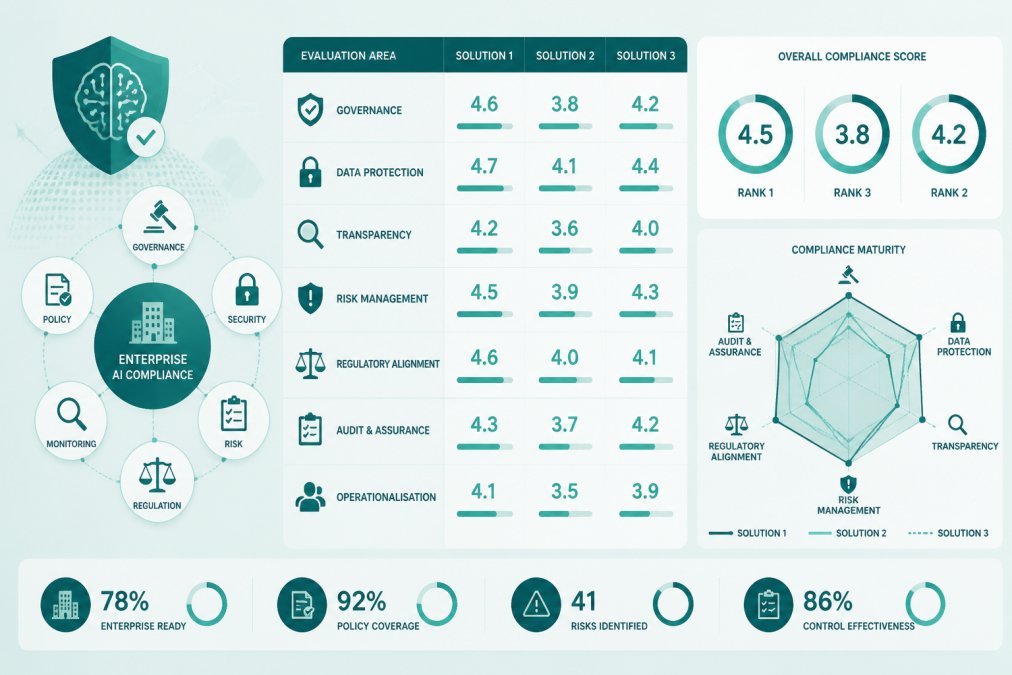
Public sector AI governance frameworks are the policies, standards and assurance processes that determine what an agency may deploy, what evidence it must produce, and who signs off. They shape deployment decisions because they define the acceptable evidence, not just the acceptable technology.
In practice, this means the framework usually decides your architecture before your engineers do. If the framework requires an audit trail linking each answer to a source, you need a retrieval system with paragraph-level citations. If it requires human review of high-impact decisions, you need workflow tooling around the model.
Mapping the Framework Landscape
Most jurisdictions now publish AI assurance guidance alongside existing privacy and records law. The OECD AI Policy Observatory tracks national approaches and is a useful starting point when mapping obligations across jurisdictions.
Three layers typically apply at once:
- Data protection law governs personal information in prompts, logs and training data
- Records and archives law governs retention of the documents the system cites
- Sector-specific assurance governs the decisions the system supports, such as benefits eligibility or licensing
A common mistake is treating these as separate workstreams owned by separate teams. They intersect at the architecture layer, and resolving them late is expensive.
Data Residency and AI Policy: The Rules That Decide Your Architecture
Data residency and AI policy requirements decide where inference runs, where logs are stored, and which subprocessors are permissible. These are architectural constraints, not settings you adjust after launch.
Start by mapping every place data touches the system:
Build a brain for your company →
| Data Type | Where It Lives | Sovereignty Risk | Typical Control |
|---|---|---|---|
| Source policy documents | Agency document store | Low if in-country | Access controls, versioning |
| User prompts | Inference environment | High if routed offshore | In-region processing |
| Vector embeddings | Vector database | Medium, can leak content | Encryption at rest, in-country hosting |
| Inference logs | Monitoring stack | High, often overlooked | Local logging only |
| Model weights | Model host | Medium, vendor-dependent | On-premise or sovereign region |
The logs row catches most teams out. Monitoring and observability tooling frequently ships data to a vendor's cloud by default, and that traffic can cross borders without anyone noticing until a privacy assessment flags it.
Where a deployment must satisfy both residency rules and an audit trail, the cleanest pattern is in-region inference with local logging, and a documented list of every external call the system makes. If a component cannot be configured to stay in-region, replace it rather than documenting an exception.
Air-Gapped and On-Premises Deployment Models
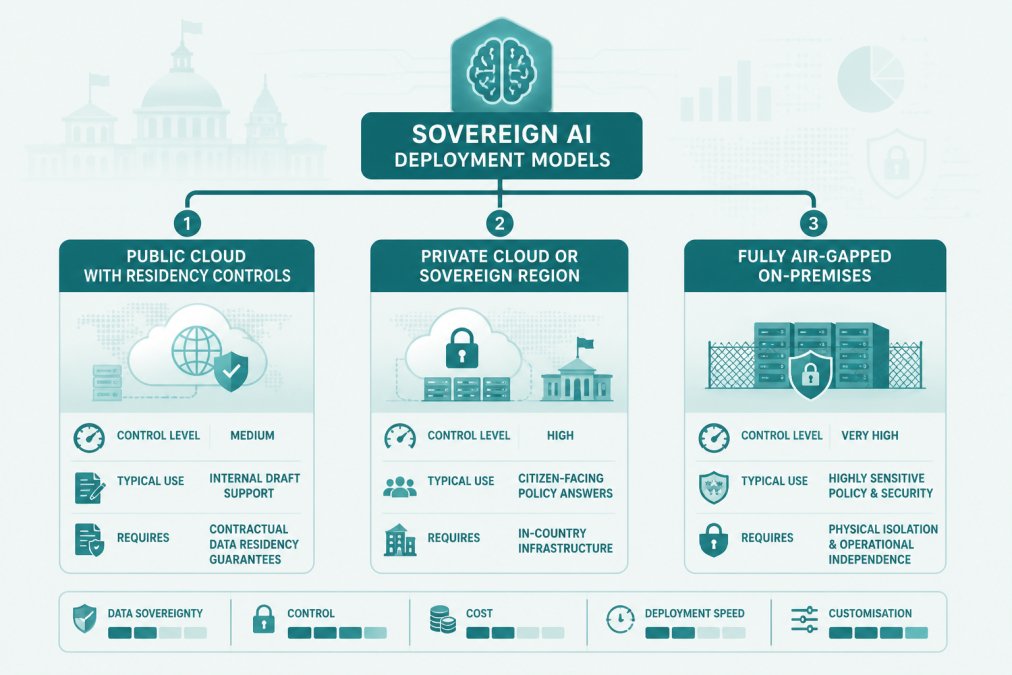
Air-gapped deployment means the AI system runs with no network path to the public internet, typically on agency-owned hardware. On-premises deployment keeps the system inside the agency's own data centres but may permit controlled outbound connections.
Air-gapped suits classified material, cabinet-level advice, and environments where any external connection is itself a policy breach. On-premises suits most other government policy work, where the requirement is control and residency rather than total isolation.
The practical differences are worth stating plainly:
- Model updates become a scheduled, reviewed process rather than an automatic one
- Hardware must be specified up front, since local GPUs determine which models you can run
- Support shifts toward the agency's own team or an in-country partner
- Failure modes are local, which is an advantage: no vendor outage takes the system down
A platform that supports sovereign, air-gap-capable and on-premises deployment, and that works across hyperscaler AI services as well as local GPUs, removes a large part of this risk. Certant is built for exactly this pattern, which is why agencies evaluating sovereign deployment tend to reach the same shortlist.
AI Knowledge Graph Implementation: Turning Policy Documents into Verifiable Answers
AI knowledge graph implementation is the process of extracting entities, relationships and citations from source documents into a structured graph that a retrieval system can query. The graph is what makes an answer verifiable: it holds the link between a claim and the paragraph it came from.
Implementation follows a recognisable sequence:
- Inventory and deduplicate the source corpus, including superseded instruments
- Extract structure such as sections, clauses, definitions and commencement dates
- Build the ontology covering the entities your policy domain actually uses
- Link documents so amendments and repeals connect to what they change
- Attach citations at paragraph level, not document level
- Test retrieval against real questions from the teams who will use it
- Monitor gaps where the graph returns nothing, and feed those back into ingestion
Step five is where most projects underdeliver. A citation pointing to a 90-page instrument is technically a citation but practically useless to a case officer who needs the operative clause (nist.gov).
Why Citations Matter More Than Model Size
A citation changes what the system is. Without one, you have a model producing plausible text about policy. With one, you have a retrieval system reporting what a specific instrument says, and a reader who can check it in seconds.
This is the difference between an answer that can be defended in a tribunal and one that cannot. It also changes user behaviour: staff who can see the source paragraph learn the policy as they work, rather than treating the system as an oracle.
The National Institute of Standards and Technology AI Risk Management Framework treats traceability and documentation as core risk controls, which aligns with what agencies already require of other decision-support systems.
Building the Business Case for Sovereign AI
Sovereign deployment costs more up front than a commercial API subscription, and the business case has to account for that honestly. The return comes from three places: reduced review time, fewer escalations, and lower compliance risk.
Time savings are the easiest to quantify. Teams that currently route every policy question through a small subject-matter expert group can measure the queue length and the handling time before deployment. Self-service answers with citations remove a large share of that queue.
Risk reduction is harder to price but often larger. A misapplied policy in a benefits, licensing or procurement decision carries remediation cost, appeals cost and reputational cost. A system that cites its source makes the error visible earlier.
Certant's approach to this is a no-install, low-risk implementation process, which matters for agencies that cannot run a lengthy pilot. Being IRAP-aligned and CPS 230 and APP 8 compliant gives assurance teams a starting point rather than a blank page.
Common Mistakes in Sovereign AI Procurement
Procurement is where sovereign AI projects are won or lost, usually before any code is written. The recurring failures follow a pattern.
Build a brain for your company →
Buying infrastructure before defining the retrieval requirement. Agencies sometimes specify air-gapped hardware, then discover the real bottleneck is document ingestion and ontology design. Hardware is the easy part to buy and the hardest to justify if the corpus is not ready.
Treating the framework as a final checklist. Governance requirements determine architecture. Teams that engage assurance late rebuild.
Assuming the vendor's model is the product. In grounded policy work, the graph and the citation layer are the product. Model choice matters far less than retrieval quality.
Skipping the superseded-document problem. Policy corpora contain amendments, repeals and transitional provisions. A system that ignores versioning will confidently cite withdrawn guidance.
The Implementation Timeline: What to Expect
A realistic sovereign AI deployment runs in phases rather than a single launch. Most of the elapsed time sits in corpus preparation and assurance, not in standing up the model.
| Phase | Typical Duration | Main Output | Common Blocker |
|---|---|---|---|
| Corpus inventory and cleanup | 4-8 weeks | Deduplicated source set | Superseded documents mixed in |
| Ontology and graph build | 4-6 weeks | Queryable knowledge graph | Domain terms not agreed |
| Retrieval and citation testing | 3-5 weeks | Verified answer set | Poor paragraph-level extraction |
| Assurance and sign-off | 4-8 weeks | Documented control evidence | Late framework engagement |
| Rollout and training | 2-4 weeks | Staff using the system | Underestimated change effort |
Two things compress this timeline. Bringing assurance in during phase one rather than phase four removes a large block of rework. Starting with a narrow, high-volume question set rather than the entire policy estate gets a usable system in front of staff sooner.
Certant's no-install implementation process is designed to shorten the early phases, and partners can retain implementation, support and integration work rather than handing it back to the vendor.
Sovereign AI deployment is a governance project with a technology component, not the reverse. Agencies that get the retrieval and citation layer right, and engage their assurance teams early, end up with a system staff actually trust. Certant builds a live knowledge graph from your own documents, returns answers with citations to the source paragraph, and supports sovereign, air-gap-capable and on-premises deployment across AWS Bedrock, Azure AI, GCP Vertex and local GPUs. Get started with Certant and give your teams verifiable answers they can defend.
Frequently Asked Questions
What is sovereign AI in the context of government policy?
Sovereign AI means the government retains control over the models, data, and infrastructure used to process policy information. In practice, that covers where data is stored, who can access it, and whether the system can run without external network connections. For policy work, it also means every answer must be traceable to a source document, so officials can verify outputs before acting on them. Deploying sovereign AI for government policy is less about the model itself and more about the governance wrapper around it.
How does sovereign AI differ from commercial AI models?
Commercial AI models typically run on vendor-controlled infrastructure, which means data leaves your environment and the vendor sets the terms. Sovereign AI keeps the model, the data, and the audit trail inside your perimeter. The practical differences show up in three areas: data residency (where information physically sits), access control (who can query the system), and verifiability (whether you can trace an answer back to a specific paragraph in a specific document). Commercial tools rarely offer all three.
What are the main challenges when deploying sovereign AI for public services?
The recurring challenges are fragmentation, verification, and skills. Policy documents usually sit across multiple systems, so any AI knowledge graph implementation has to unify them before it can answer anything useful. Verification is the second hurdle: officials need citations, not confident guesses. The third is operational: IT teams are stretched, so the platform has to be manageable without specialist AI staff. Getting these three right matters more than model choice.
How can governments maintain data control while using AI?
Data control comes down to architecture choices made before deployment, not settings applied afterwards. Air-gapped or on-premisessss deployment keeps data inside the perimeter. Role-based access controls determine who can query which documents. A verifiable knowledge graph ensures every answer cites its source, which satisfies auditors and supports data residency and AI policy requirements. The key is deciding these constraints upfront, because retrofitting them into a cloud-first system is expensive and slow.
Why is sovereign AI considered essential for national security?
Policy and security information often cannot leave national borders or government networks, which rules out most commercial AI services. Sovereign deployment keeps sensitive material inside controlled infrastructure and removes reliance on foreign providers who could change terms, pricing, or availability without notice. It also supports air-gapped operation, so systems keep working even without external connectivity. For agencies handling classified or sensitive policy work, these constraints are non-negotiable rather than optional.
What does an AI knowledge graph implementation involve?
An AI knowledge graph implementation starts by ingesting your existing documents, then mapping the relationships between them: which policy references which regulation, which clause supersedes which precedent. Once that structure exists, the system can answer questions with citations to specific paragraphs rather than generating text from memory. Implementation typically involves connecting source systems, defining access rules, and testing answer accuracy against known cases before going live.
Can sovereign AI systems show auditors how an answer was reached?
Yes, if the platform is built for verifiability. A knowledge graph approach links every answer to the source paragraphs it drew from, so auditors can see exactly which document and which clause produced a given output. This is different from a chatbot that generates plausible text with no traceable origin. For regulated environments, the audit trail is often the deciding factor between a system that passes review and one that does not.
How long does it take to see results from a sovereign AI deployment?
Timelines depend on how many source systems need connecting and how much document cleanup is required. A focused deployment, say policy Q&A for one department, can show useful answers within weeks rather than months. Broader rollouts across multiple agencies take longer because access rules and data mappings multiply. The practical advice is to start with one high-volume use case, prove the citations work, then expand.
Frequently asked questions
What is sovereign AI in the context of government policy?
Sovereign AI means the government retains control over the models, data, and infrastructure used to process policy information. In practice, that covers where data is stored, who can access it, and whether the system can run without external network connections. For policy work, it also means every answer must be traceable to a source document, so officials can verify outputs before acting on them. Deploying sovereign AI for government policy is less about the model itself and more about the governance wrapper around it.
How does sovereign AI differ from commercial AI models?
Commercial AI models typically run on vendor-controlled infrastructure, which means data leaves your environment and the vendor sets the terms. Sovereign AI keeps the model, the data, and the audit trail inside your perimeter. The practical differences show up in three areas: data residency (where information physically sits), access control (who can query the system), and verifiability (whether you can trace an answer back to a specific paragraph in a specific document). Commercial tools rarely offer all three.
What are the main challenges when deploying sovereign AI for public services?
The recurring challenges are fragmentation, verification, and skills. Policy documents usually sit across multiple systems, so any AI knowledge graph implementation has to unify them before it can answer anything useful. Verification is the second hurdle: officials need citations, not confident guesses. The third is operational: IT teams are stretched, so the platform has to be manageable without specialist AI staff. Getting these three right matters more than model choice.
How can governments maintain data control while using AI?
Data control comes down to architecture choices made before deployment, not settings applied afterwards. Air-gapped or on-premisessss deployment keeps data inside the perimeter. Role-based access controls determine who can query which documents. A verifiable knowledge graph ensures every answer cites its source, which satisfies auditors and supports data residency and AI policy requirements. The key is deciding these constraints upfront, because retrofitting them into a cloud-first system is expensive and slow.
Why is sovereign AI considered essential for national security?
Policy and security information often cannot leave national borders or government networks, which rules out most commercial AI services. Sovereign deployment keeps sensitive material inside controlled infrastructure and removes reliance on foreign providers who could change terms, pricing, or availability without notice. It also supports air-gapped operation, so systems keep working even without external connectivity. For agencies handling classified or sensitive policy work, these constraints are non-negotiable rather than optional.
What does an AI knowledge graph implementation involve?
An AI knowledge graph implementation starts by ingesting your existing documents, then mapping the relationships between them: which policy references which regulation, which clause supersedes which precedent. Once that structure exists, the system can answer questions with citations to specific paragraphs rather than generating text from memory. Implementation typically involves connecting source systems, defining access rules, and testing answer accuracy against known cases before going live.
Can sovereign AI systems show auditors how an answer was reached?
Yes, if the platform is built for verifiability. A knowledge graph approach links every answer to the source paragraphs it drew from, so auditors can see exactly which document and which clause produced a given output. This is different from a chatbot that generates plausible text with no traceable origin. For regulated environments, the audit trail is often the deciding factor between a system that passes review and one that does not.
How long does it take to see results from a sovereign AI deployment?
Timelines depend on how many source systems need connecting and how much document cleanup is required. A focused deployment, say policy Q&A for one department, can show useful answers within weeks rather than months. Broader rollouts across multiple agencies take longer because access rules and data mappings multiply. The practical advice is to start with one high-volume use case, prove the citations work, then expand.