Automated Policy Compliance for Large Enterprises
Learn how automated policy compliance helps large enterprises reduce risk and save time. Explore best practices, examples, and a clear implementation.
Table of Contents
- Why Manual Policy Compliance Is Failing Large Enterprises
- What Automated Policy Compliance Actually Means
- Automated Policy Enforcement Examples in Regulated Sectors
- Compliance Automation Best Practices for Enterprise Rollouts
- Continuous Compliance Monitoring: Moving from Annual Audits to Real-Time Oversight
- Your Compliance Automation Implementation Roadmap
- Common Mistakes to Avoid When Automating Compliance
- Conclusion: Start Small, Scale with Confidence
- Frequently Asked Questions
Last Updated: 9 September 2026
Why Manual Policy Compliance Is Failing Large Enterprises
Manual policy compliance is no longer sustainable for large enterprises because the sheer volume of regulations, internal policies, and contractual obligations has outpaced what human review can reliably manage. Spreadsheet trackers, email chains, and shared drives create a fragmented picture where a single missed update can lead to significant regulatory exposure. This guide from Certant explains how automated policy compliance for large enterprises shifts the burden from reactive checking to proactive, continuous verification.
The core problem is that compliance teams spend their time hunting for documents rather than assessing risk. When a new regulation lands, someone must manually determine which existing contracts, internal policies, or supplier agreements are affected. The UK Information Commissioner's Office guidance on accountability frames this challenge well, noting that organisations must be able to demonstrate their compliance efforts, not just assert them. Manual processes rarely leave an audit trail that satisfies that standard.
What most guides miss is that the failure is not about effort. It is about architecture. Information sits in silos: contracts in one system, HR policies in another, and operational procedures in a filing cabinet or legacy platform. Automated policy compliance solves this by connecting those sources into a single, queryable knowledge base. That connection is the difference between a compliance function that reacts and one that anticipates.
What Automated Policy Compliance Actually Means
Automated policy compliance is the use of technology to continuously monitor, interpret, and enforce an organisation's policies and regulatory obligations against its actual documents and data. It is not a simple rules engine that flags missing signatures. A mature system builds a live knowledge graph from internal documents, allowing it to understand context, relationships, and obligations across different sources. Automatic Ontology based on your business is what turns that raw document pile into a structured map of how policies, contracts, and obligations relate to one another.
This matters because policies are rarely standalone. A single procurement contract may reference data protection clauses, anti-bribery provisions, and financial limits. A rules engine checks each item in isolation. A knowledge graph understands that a change to the parent policy affects dozens of sub-contracts simultaneously.
The practical difference shows up in daily work. Instead of a compliance officer manually reading a 50-page contract, the system automatically reviews incoming agreements against current policy. It flags clauses that deviate from approved standards, highlights missing required terms, and provides the source paragraph for each flag. This turns a four-hour review into a verification task that takes minutes.
Automated Policy Enforcement Examples in Regulated Sectors
Seeing the theory applied in practice clarifies what is possible. These automated policy enforcement examples show how different industries use the same underlying technology to solve distinct problems.
Contract Risk Flagging for Financial Services
Financial services firms review a high volume of contracts, each carrying potential regulatory risk under frameworks like CPS 230 (apra.gov.au). A common approach is to deploy systems that automatically scan incoming agreements for clauses that conflict with approved policy templates. The system flags deviations in real time, directing the contract team's attention to genuine risks rather than routine language. This reduces the bottleneck of manual review and ensures that no contract slips through without proper scrutiny.
Document-Driven Workflow Automation in Healthcare
Healthcare organisations manage complex, document-heavy workflows where policy compliance is tied to patient safety and data handling. Automation here means routing documents through approval chains based on their content. A policy update that affects patient consent forms, for instance, triggers a workflow that notifies the relevant department heads, tracks their sign-off, and archives the version history. This removes the reliance on email reminders and manual follow-ups.
Instant Policy Answers for HR and Knowledge Teams
HR teams at large enterprises field the same policy questions repeatedly. Automated policy compliance provides staff with instant, verifiable answers drawn directly from the policy library. When an employee asks about parental leave or expense limits, the system returns an answer with a citation to the exact source paragraph. This reduces the burden on HR and ensures that the information provided is always the current, approved version.
Build a brain for your company →
Compliance Automation Best Practices for Enterprise Rollouts
Treating automation as a technology project rather than a change management exercise is the most common reason rollouts stall. The technology may be sound, but if the compliance team does not trust it, adoption fails.
Start by defining what success looks like in measurable terms. Is the goal to reduce contract review time, to cut the number of policy breaches, or to shorten audit preparation? Each goal points to different metrics and different system configurations.
A second best practice is to involve the audit function early. Auditors will want to see how the system arrived at an answer. If the platform cannot show its reasoning and source documents, it is effectively a black box, and that is rightly a concern for regulated firms. Look for systems that provide a transparent audit trail, showing which version of a policy was in force when a decision was made.
Finally, plan for data quality issues. The system is only as good as the documents it ingests. In practice, this means allocating time to clean up legacy files, remove duplicates, and tag documents with metadata before the full rollout. autonomous agent lifecycle management.
Continuous Compliance Monitoring: Moving from Annual Audits to Real-Time Oversight
The shift from annual audits to continuous compliance monitoring is the most significant change automation brings. An annual audit is a point-in-time snapshot. It tells you that your organisation was compliant on the day the auditor looked, and it offers little assurance for the other 364 days.
Continuous monitoring changes the question from "were we compliant last quarter?" to "are we compliant right now?". The system watches for changes, both internal and external. When a new regulation is published, it identifies affected policies and contracts. When a supplier agreement is renewed with altered terms, it checks those terms against current policy immediately. AI Agents can take this further by acting on those incoming changes without waiting for a human to spot them.
This approach also changes how compliance teams spend their time. Instead of a frantic push before an audit, the team works steadily throughout the year, addressing flags as they arise. The audit becomes a confirmation of what the system has already verified, rather than a discovery exercise.
Your Compliance Automation Implementation Roadmap
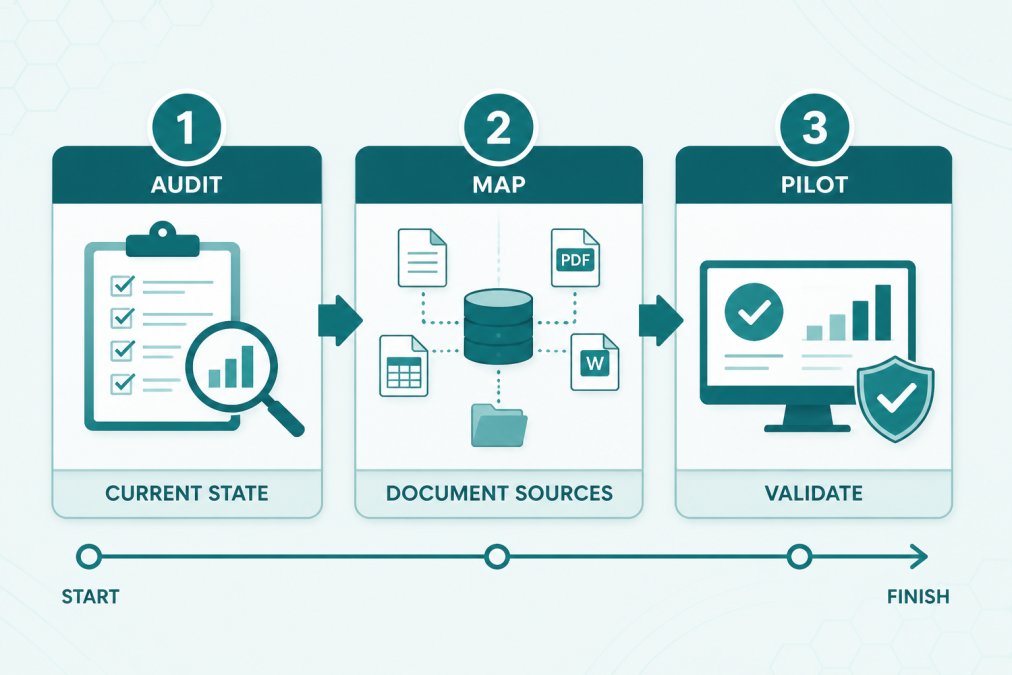
A phased implementation roadmap reduces risk and builds confidence across the organisation. Trying to automate everything at once is a recipe for failure. A structured approach, moving from discovery to validation, is more likely to deliver lasting results.
Phase 1: Audit Your Current State
Begin by mapping your existing compliance landscape. Identify which regulations apply to your organisation, which internal policies govern daily operations, and where the gaps are between them. This phase is about understanding the current state before you try to improve it. Document the manual processes in place, note where information lives, and flag the areas where breaches are most likely to occur.
Phase 2: Map Document Sources
The second phase is connecting the system to your document sources. For most enterprises, this means integrating with SharePoint, legacy case management platforms, and other repositories where policies and contracts reside. A platform like Certant pulls this fragmented information into a coherent knowledge graph, so the system understands the relationships between documents. This step is where the quality of the underlying data becomes critical.
Phase 3: Pilot and Validate
Run a pilot with a single, well-defined use case before expanding. Choose a process that is document-heavy and where compliance risk is clear, such as contract review in the legal department. Validate that the system correctly flags risks and that the answers it provides match what your compliance team would expect. This phase builds the trust needed for a wider rollout.
Build a brain for your company →
| Phase | Core Activity | Typical Outcome |
|---|---|---|
| Phase 1: Audit | Map regulations, policies, and gaps | Clear picture of current risk |
| Phase 2: Map Sources | Integrate document repositories | Unified knowledge graph |
| Phase 3: Pilot | Test on a single use case | Validated, trusted system |
Common Mistakes to Avoid When Automating Compliance
The first mistake is treating the tool as a replacement for human judgment. Automation excels at surfacing risks and providing consistent answers, but it does not replace the nuanced assessment of a senior compliance officer. The goal is to give that officer better information faster, not to remove them from the process.
A second mistake is underestimating the effort required for data preparation. Most enterprises have documents scattered across multiple systems, including legacy platforms that no one fully understands. The National Archives guidance on records management highlights that effective information governance starts with understanding what you hold. Skipping the cleanup phase means the system will produce unreliable results, and that erodes trust quickly.
A third error is failing to plan for ongoing maintenance. Policies change, regulations update, and new contracts are signed. The system needs continuous feeding and occasional tuning to remain accurate. Assign ownership for this maintenance before you launch, not after problems appear.
Conclusion: Start Small, Scale with Confidence
Automated policy compliance for large enterprises is not a single purchase; it is a shift in how compliance work gets done. The organisations that succeed are those that start with a clear problem, validate the solution on a small scale, and then expand with evidence in hand. They also choose platforms that provide verifiable answers with citations, ensuring the audit trail remains intact.
At Certant, we build a live knowledge graph from your internal documents and data, giving your team verifiable, context-specific answers and automatic risk flags on incoming contracts. Our platform supports sovereign, air-gap-capable, and on-premises deployments, aligning with frameworks like CPS 230 and APP 8, and is compatible with AWS Bedrock, Azure AI, GCP Vertex, and local GPUs. The implementation is low-risk and requires no specialist staff to maintain.
If your compliance team is still reviewing contracts manually or scrambling before each audit, the gap between your current state and what automation offers will only widen. Start with a single use case, prove the value, and scale from there. Get started with Certant and see how automated policy compliance can give your team the confidence to move from reactive checking to continuous oversight.
Frequently Asked Questions
What is automated policy compliance?
Automated policy compliance uses software to check business activities, contracts, and documents against your internal policies and external regulations without manual review. Instead of staff reading every clause, the system flags risks, provides verifiable answers with citations to source paragraphs, and routes exceptions for human review. For large enterprises, this shifts compliance from a reactive, periodic check to a continuous process embedded in daily workflows. The goal is to reduce human error and free up teams for higher-value work.
Why is compliance automation essential for large organisations?
Large organisations manage thousands of documents across SharePoint, case management platforms, and legacy systems. Manual policy checks cannot keep pace with that volume. Compliance automation unifies these fragmented sources into a single knowledge graph, so every answer traces back to a source paragraph your auditors can verify. It also reduces operational risk by flagging issues as they arise, not at the next quarterly review. For regulated sectors, this speed and traceability are the difference between a minor fix and a reportable breach.
How do you transition from manual to automated compliance?
Start with an audit of your current document landscape. Identify where policies live, who owns them, and which workflows create the most compliance risk. Then map those sources into your automation platform, whether that is a knowledge graph or a rules engine. Run a pilot on one high-volume process, such as contract review, and compare results against your manual baseline. Validate the system's answers with your compliance team before expanding to other departments. Most platforms, including Certant, offer a no-install implementation that existing IT teams can manage.
How does compliance automation reduce operational risk?
Automated policy compliance reduces risk by removing the gaps where human review misses details. A contracts team spending four to five hours per agreement will inevitably overlook clauses, especially under deadline pressure. Automation flags non-standard terms instantly and provides citations to the relevant policy section. It also enables continuous compliance monitoring, so new documents are screened as they enter the system rather than at the next audit cycle. This creates an audit trail that shows exactly how each decision was reached.
Frequently asked questions
What is automated policy compliance?
Automated policy compliance uses software to check business activities, contracts, and documents against your internal policies and external regulations without manual review. Instead of staff reading every clause, the system flags risks, provides verifiable answers with citations to source paragraphs, and routes exceptions for human review. For large enterprises, this shifts compliance from a reactive, periodic check to a continuous process embedded in daily workflows. The goal is to reduce human error and free up teams for higher-value work.
Why is compliance automation essential for large organisations?
Large organisations manage thousands of documents across SharePoint, case management platforms, and legacy systems. Manual policy checks cannot keep pace with that volume. Compliance automation unifies these fragmented sources into a single knowledge graph, so every answer traces back to a source paragraph your auditors can verify. It also reduces operational risk by flagging issues as they arise, not at the next quarterly review. For regulated sectors, this speed and traceability are the difference between a minor fix and a reportable breach.
How do you transition from manual to automated compliance?
Start with an audit of your current document landscape. Identify where policies live, who owns them, and which workflows create the most compliance risk. Then map those sources into your automation platform, whether that is a knowledge graph or a rules engine. Run a pilot on one high-volume process, such as contract review, and compare results against your manual baseline. Validate the system's answers with your compliance team before expanding to other departments. Most platforms, including Certant, offer a no-install implementation that existing IT teams can manage.
How does compliance automation reduce operational risk?
Automated policy compliance reduces risk by removing the gaps where human review misses details. A contracts team spending four to five hours per agreement will inevitably overlook clauses, especially under deadline pressure. Automation flags non-standard terms instantly and provides citations to the relevant policy section. It also enables continuous compliance monitoring, so new documents are screened as they enter the system rather than at the next audit cycle. This creates an audit trail that shows exactly how each decision was reached.